Quantum World AI : The Future Wave
[Keep updating / Not Finished]
https://www.youtube.com/watch?v=q2rR_aXjqnI
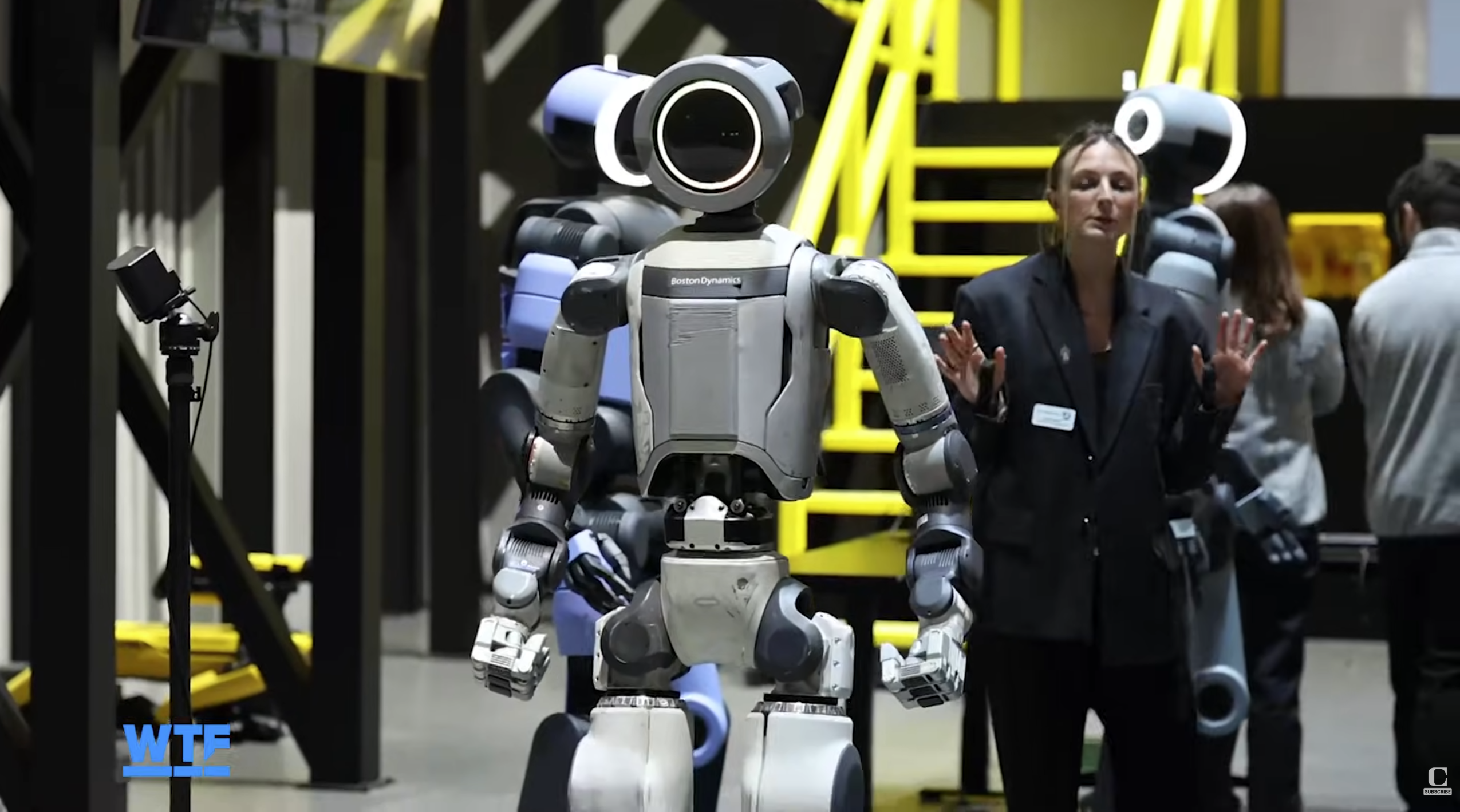
Boston Dynamics’ humanoid robot Atlas, unveiled at CES 2026, became one of the event’s biggest talking points. Barely three years after the debut of ChatGPT in November 2022—which delivered a disruptive shockwave through large language models (LLMs)—the world is now turning its attention to Physical AI: intelligence that operates in the real world under the constraints of physical laws. Alongside autonomous driving spearheaded by Tesla and others, robotics stands as another major pillar of this Physical AI era.
Robotics Converging with AI
For decades, humanoid locomotion—robots capable of general-purpose use in a human form—has been a persistent technological ambition. In practice, however, humanoids face formidable challenges: stable bipedal walking, dexterous manipulation, continuous balance control, and robust recovery from perturbations.
A key inflection point has been the emergence of modern AI. Much like how humans learn to walk through repeated trial and error, machines can learn locomotion and manipulation policies through large-scale experience and iterative optimization. Yet learning purely through real-robot trial runs is prohibitively inefficient—expensive, slow, and risky for hardware.
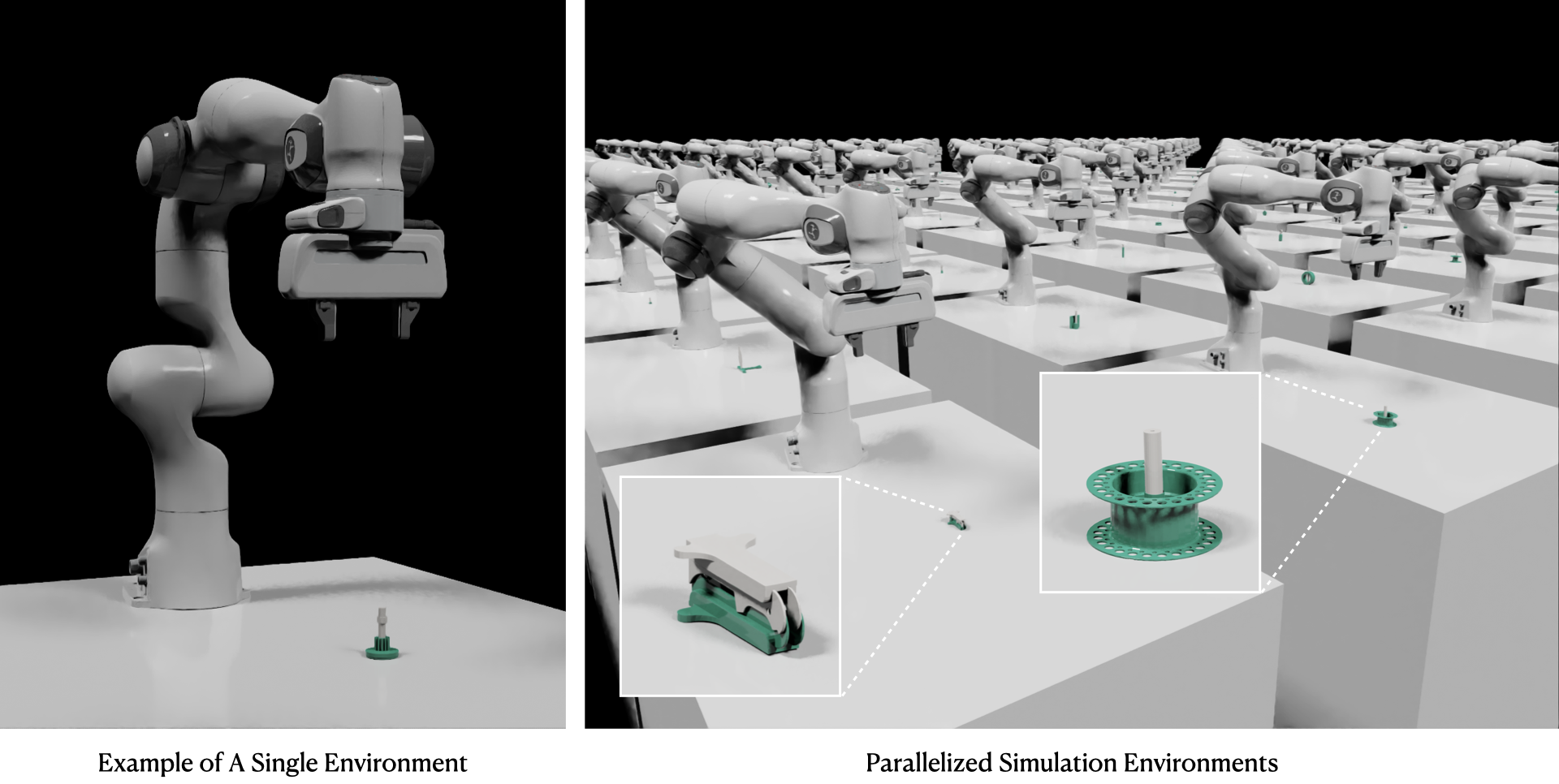
This is where sim-to-real transfer enters the picture.
Training is conducted inside a physics-engine-based simulation and then transferred to the real world. In essence, simulation incorporates physical laws to generate vast quantities of experience and datasets that would be infeasible—or outright impossible—to collect in reality. In robotics, the required physics engines have been relatively straightforward to implement, which is why the field was able to capitalize quickly once AI and machine learning matured.
But what if the domain is one where building high-fidelity simulations is intrinsically difficult—such as the quantum regime?
Quantum World AI
At present, quantum-mechanics-based simulation remains challenging due to computational limits. However, given the recent trajectory of computing power, it seems plausible that we are not far from achieving substantially improved simulation fidelity in this space. Ultimately, once an AI-trainable simulation environment exists, we may enter an era in which AI systems search for optimal solutions within those simulated worlds.
One additional consideration is that quantum computing (QC) could naturally occupy a meaningful position within this blueprint. High-quality simulation will take time to mature—and over that same period, QC may advance substantially. I think it is useful to split this into two broad pathways:
- Digital/analog QC as a device for simulating quantum-mechanical phenomena, i.e., a computational substrate for building the simulator itself.
- Quantum Machine Learning (QML) enabled by QC progress, i.e., new learning paradigms and accelerations that emerge as quantum hardware and algorithms mature.
In what follows, I will outline—at a high level—a four-stage blueprint for (i) the quantum digital-twin environment used to train “Quantum World AI,” and (ii) the AI systems trained within it. The future I envision looks like this.
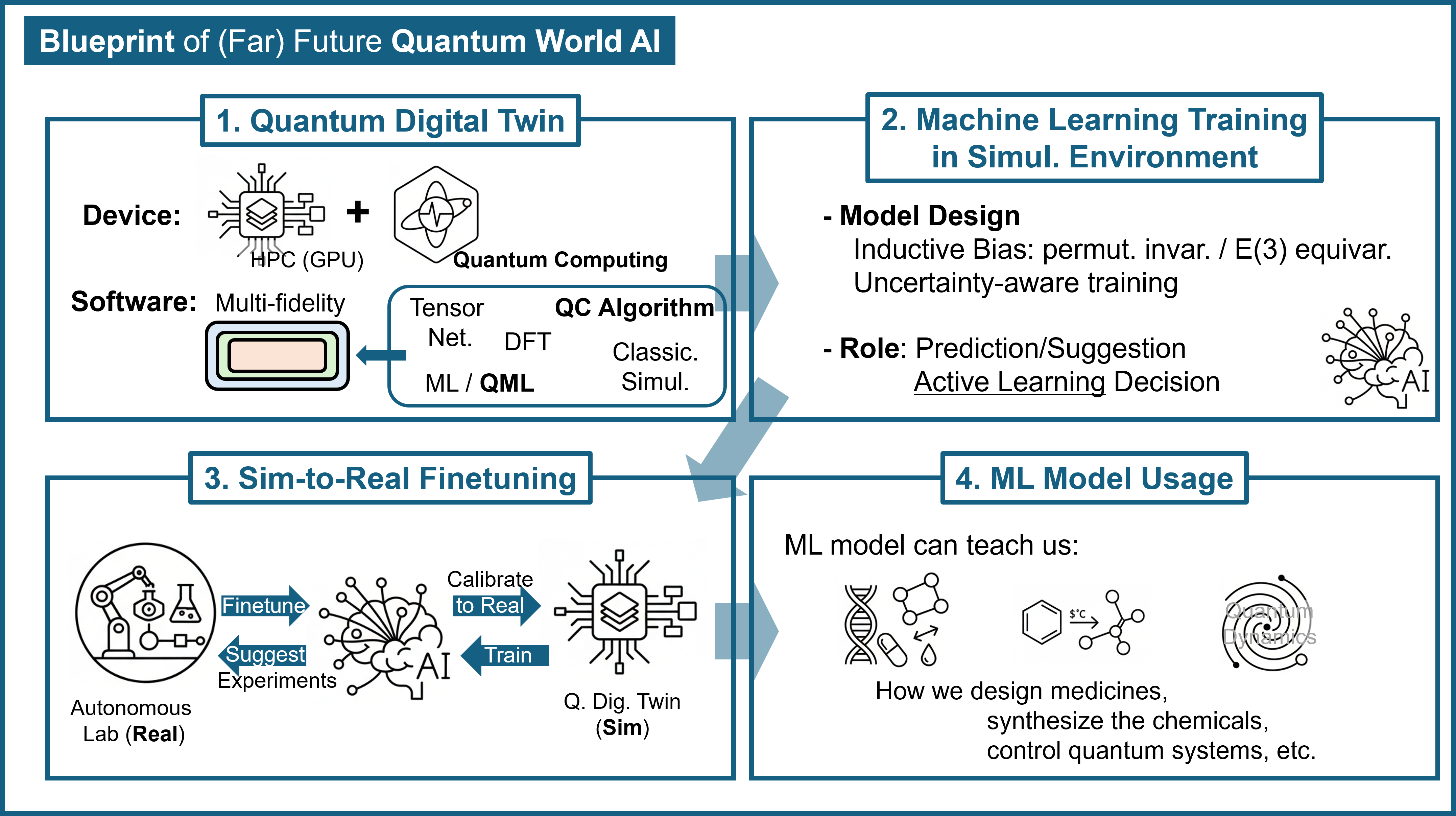
1. Quantum Digital Twin
| Key Concept | Multi-fidelity, Uncertainty quantification, Workflow Management |